 “I don’t want to go to the beach today, it’s full of algae!” Constant whining. That is what my parents, and many other Sardinian parents, had to endure whenever Mistral blew strongly and brought “trash” to the shore, or so it seemed to me.
My statement had been repeated over the span of generations, echoed by tourists who land on a Mediterranean beach and are faced with a field of brown material covering the sand. Every summer, tourism operators put pressure on regional coastal authorities to promptly remove the washed up “algae” – they’re not a good look; they’re dissonant with the crystal blue waters that draw tourists from all over the world. But that brown residue is what keeps those waters crystal clear.
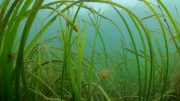
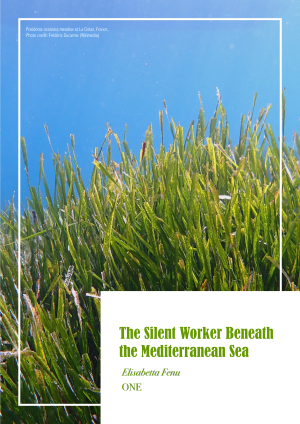
What locals call “algae” are actually washed-up leaves of Posidonia oceanica (or “P. oceanica”), a different and more complex organism than algae. It is a large aquatic plant with roots capable of forming extensive underwater meadows, actively working as the “beating heart” of the salty Mediterranean Sea. At some point in the year, old leaves detach from the meadows and float away, washing up on the shore, and accumulating in the so-called banquettes.
Ancient Underwater Forests
The Mediterranean basin holds 18% of identified marine species, presenting a marine biodiversity greater than the one of the Atlantic Ocean, as indicated in a 2000 publication by Bianchi and Morri. P. oceanica stands among this richness as the only endemic marine phanerogam species and the most widespread. It primarily reproduces asexually, spreading through rhizomes, thus creating clones. A study by Arnaud-Haond et al. published in 2012 on PLOS ONE suggests that certain meadows, composed by a single clonal organism, can be as old as 100.000 years.
Albeit less frequently, much like how plants behave on land, it can flower in autumn and produce its free-floating fruit (commonly referred to as “olive of the sea”) in spring. Its meadows cover roughly 1.5 % of the Mediterranean basin, extending for more than 20.000 km2 along coastal areas, and constituting the climax community – the mature final stage of an ecosystem’s development. Constrained by light availability, P. Oceanica generally grows between a depth of 0.5 and 45 meters to sustain photosynthesis.
Keeping The Mediterranean Blue
Cradled by the waves, and sheltered by the lush, thick expanses, many fish species find their nursery in the meadows of P. oceanica. These are known to support biodiversity and to offer a suitable habitat for thousands of marine species during the various phases of their life cycle, also guaranteeing a steady output for local commercial activities.
Similarly to some categories of wetlands, P. oceanica meadows are included in the “Blue Carbon” ecosystems thanks to their ability to work as carbon removal powerhouses. They can sequester carbon dioxide up to twice as much as terrestrial forests per hectare (even more than the Amazon forest!), storing around 5.7 million tons annually, therefore acting as essential tools for climate change mitigation.
They are also important coastal shoreline protectors, capable of building and securing sediment, thus reducing the effects of sea-level rise and coastal erosion. This leads to a reduction in hydro dynamism, which also contributes to seawater purification by reducing turbidity and trapping pollutants, resulting in clearer waters.
Posidonia acts as an incredible bioindicator thanks to its key characteristics: long-lived, sensitive to disturbance, habitat-forming and widespread all over the Mediterranean basin.
Late professor, researcher and science communicator Monica Montefalcone greatly contributed to the understanding of P. oceanica as a bioindicator, demonstrating much wider assessment applications than previously thought by the community. Her single-authored paper, published in 2009, titled “Ecosystem health assessment using the Mediterranean seagrass Posidonia oceanica: A review”, suggests that not only is P. oceanica a great monitoring system for water quality under the EU Water Framework Directive, but it’s a great tool to assess broader ecological degradation, highlighting the distinction between these two, and presenting a more effective basin-wide method to establish the health of such ecosystems. In some cases, water quality indicator results can be acceptable, but that does not mean structural disturbances aren’t happening.
A recent 2024 study published in Environmental Pollution conducted by Martinez et al. suggests that P. oceanica meadows are good at trapping microplastics. While this can decrease microplastics concentration in the water, it also affects the organisms that find shelter and/or food within the habitat.
Workers’ Rights
Posidonia is classified as “Least Concern” in the International Union for Conservation of Nature (IUCN) List of Threatened Species, showing a high resilience to seawater temperature variations and invasion by alien species, while still being widely distributed. However, it is weaker to salinity fluctuations, turbidity and sedimentation rate. A 2015 analysis carried out by Telesca et al. indicates that P. oceanica distribution decreased by 34% in the last 50 years. Many findings confirmed that meadow fragmentation was mostly due to anthropogenic disturbances.
One of these findings was presented by Monica Montefalcone as the lead author of a 2010 paper, published in Estuarine, Coastal and Shelf Science, that showed P. oceanica habitat fragmentation is strongly linked to human activity and is more intense in anthropized areas.
A 2025 World Wide Fund for Nature (WWF) report on marine phanerogam meadows conservation lists marine pollution, coastal development, illegal trawling, climate change and boat anchoring as the main threats, with the latter representing the key threat to address. Boat anchors often penetrate the seabed and uproot the plants, leading to habitat degradation. P. oceanica is a slow-growing plant (1-6 cm per year), so recovering such structural damage can prove difficult if not very unlikely. The message fundamentally conveyed is that prevention is way more sustainable than restoration.
Despite being protected by the EU Habitats Directive (Council Directive 92/43/EEC), and by the Bern and Barcelona conventions, tourism – of the not sustainable type – and illegal practices swim against the current of conservation efforts.
How to Handle the End
P. oceanica debris washing ashore, forming the infamous banquettes, becomes a part of the ecosystem. Banquettes can cover hundreds of meters and reach a height of 2 meters, actively serving as a food source for detritivores and crustaceans. Sand can become trapped in between debris layers, thus its removal from the beach, for aesthetic and touristic purposes, is truly damaging.
Albeit visually unattractive, banquettes also help mitigate wave impact and therefore should not be removed. Finding the balance between environmental protection and tourism is quite a feat: although banquette management has greatly improved over the years, a direct, unifying law for its protection doesn’t exist.
In 2010 the Italian Superior Institute for Environmental Research and Protection (ISPRA) published an influential guide on how to manage banquettes, proposing the “Ecological Beach” model, which successfully helped to optimize conservation efforts in many Italian regions.
The European Union also funded related projects (POSBEMED) for coastline management in Natura 2000 and protected areas. Unfortunately, these guidelines aren’t always enforced, especially in tourism hotspots. Nonetheless, banquettes are a sign that the nearby waters are clean, clear and in good condition.
Protecting The Treasure
Data on P. oceanica decline and distribution is still very region-specific and fragmented. That is why mapping meadows, studying their resilience and their services is an invaluable contribution to marine ecology, and ultimately, to the planet’s well-being.
For this reason, many researchers work relentlessly to make sure the treasure that rests beneath the Mediterranean Sea stays protected.
Unfortunately, in May 2026, the world lost several of them during a tragic diving accident.
Monica Montefalcone was one of the world’s leading experts in P. oceanica, lending a voice to its otherwise silent but impactful presence. She was a professor at the University of Genoa and an active science communicator, often appearing in popular scientific television programs. Her love for marine life permeated every room she walked in, and she quickly became a favourite among university students. Everybody can learn, not everybody can teach.
That is how she passed away, teaching to some of her students – and her daughter – how to assess the health of coral reefs while diving at the Maldives.
Due to the circumstances, worldwide media coverage mostly focused on how she died, often blaming her for the poor decisions that allowed for the tragedy to unfold. Just like that, all the work she has done over the years has been eclipsed by an avalanche of negative opinions from people who don’t even know her, or her discipline. The truth is, nobody knows exactly what happened yet, and whatever decision led to her and her students’ passing can’t possibly compare to her valuable contribution to ecosystem conservation and science communication.
A Long, Ancient Cycle
Beachgoers only see the final stage, when the leaves turn brown and lay still, often failing to acknowledge the silent work P. oceanica has done during its lifetime. Learning about it and spreading awareness, even in informal settings, is the best way an individual can help conservation efforts.
It can be accomplished through a simple action, like reminding people not to call banquettes “algae” or explaining those are like the leaves that fall off the trees in autumn, there to reassure us that the sea is still full of life and somewhat okay.
In the same way, learning about Professor Montefalcone and sharing her immense contribution to the protection of marine ecosystems can tear down the thin but opaque curtain of hate woven by ignorance. Only then may people understand how rare it was to be in the presence of someone who didn’t just teach but passed on her love for marine life to whoever listened.
That is how science should be: welcoming, not exclusionary. Knowledge is a long, ancient cycle of team efforts after all.
In the meantime, Posidonia oceanica will continue its own ancient cycle: the clones will be produced, the flowers will bloom, the fruits will appear, and the leaves will eventually die, finally floating away to gracefully rest on a Mediterranean beach, while still protecting the land and giving nutrients back to the ecosystem they kept alive.
To give recognition to Posidonia oceanica is to give recognition to life itself.
Elisabetta Fenu
«One of my hopes – one of my dreams,
is to be remembered. That my work
will be carried on in the future by those
who come after me, as I did with those
who came before me and taught me
everything I know now.»– Monica Montefalcone (1974-2026)
-

By: ONE Team
ONE is a nonprofit magazine founded in 2014, dedicated to providing unbiased and independent commentary and reporting on energy and environment issues. ONE policy pursues the following principles: accuracy, integrity and transparency.
Only Natural Energy provides original articles and also a selection of other sources most explanatory posts about climate change, new technologies, policies and strategies in the energy field. -