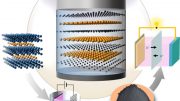
 Since both solar and wind generated electricity are variable and uncertain in timing and amount, some will be wasted unless some means of storing the electricity is made available. Hence, the concept of a ‘Battery Electric Storage System’ or BESS, potential energy storage as a reversible chemical reaction. The capacity of a single battery is small, so the typical BESS installation has thousands of them. It tends to be quite expensive. Also, the life span is not all that long.
Other forms of storing potential energy exist. One of these is water at a height, ready to be sent down a tube to a water turbine attached to an electricity generator. The scale is usually large. Pumped storage refers to water in two ponds at different heights, transfers from the lower to upper pond being in off-peak times, while the generating is done to meet daily peak demand. Doing this on a smaller scale is certainly possible. One attractive feature is the long life of the equipment.
A step-wise assistance from gravity in lifting water can lower costs. A bit of history about a vacuum and its power helps understand this. In the mid 1600s in Magdeburg, Germany, lived a man curious about what might exist between heavenly bodies. Might it be a vacuum?
He decided to create one in order to understand it better, and was surprised at the effort it took and how strong the vessel containing the vacuum had to be. Pumping air out of a vessel was at first easy but soon became increasingly hard. Even a partial vacuum is pretty powerful.
This was Otto von Guericke and today in Magdeburg is a university bearing his name. It was created shortly after German reunification; Magdeburg had been in the East.
His research informed the design of Newcomen’s engine built in 1712 in England, the first really successful one. Atmospheric pressure pushed a piston down a cylinder into a partial vacuum created by condensing steam below the piston in a fine spray of water.
Using a partial vacuum to take advantage of atmospheric pressure to do work can be applied to the lifting of water. One way is to use a series of sealed units each strong enough not to collapse due to the degree of vacuum it has. This depends on the height water is to be lifted between two such units. Less than two metres is likely best, though it could be a few more. At sea level atmospheric pressure can balance a column of water 10.3 metres high, so a lift of a metre or two is a workable partial vacuum.
A unit may be configured several ways, the key aspects being few. Three openings are needed in each unit: one a little below the top surface for the placing of a valve; plus one in the bottom surface and another in the top surface. Each of these will have a riser tube or pipe sealed in it. Risers are more or less identical. The exterior part is a stub to be attached by hose or pipe to the unit above and below it. The interior part is a tube or pipe extending to the opposite side of the unit leaving a short gap.
Two units work in tandem: the one below is nearly full of water, its valve open to the air; the above unit with little water has its valve connected to a source of suction. The difference in pressure, atmospheric below and less above, causes water to flow up the risers. This continues until the above unit is nearly full of water, when its valve changes to be open to the air, while the other unit becomes open to the source of suction.
Each unit alternates between being in above mode and below mode; water moves upward through the sequence of units, however many there are. As each step is a short lift, the degree of suction needed is quite small. The volume of suction needed may be large: it depends on the total height water is being lifted and the volume being lifted that high.
Sources of suction
Wind is one of several ways to create a partial vacuum. A vertical axis windmill, like Savonius in Finland designed in the 1920s, can use wind from any direction. Moderately strong winds may turn it at several hundred revolutions per minute (rpms). With much stronger winds it needs some sort of brake to keep it from turning too rapidly.
As von Guericke discovered, it becomes increasingly difficult to remove air from a closed vessel as the degree of vacuum increases. This could work as a natural brake for a vertical axis windmill removing air from a relatively small capacity braking vessel connected to a much larger volume of air in a pipe kept at, or above, the lesser degree of partial vacuum wanted for a stepped lifting of water by use of atmospheric pressure.
Several such windmills with braking vessels could be linked to the same pipe. In normal operation the degree of vacuum in a braking vessel would be only somewhat greater than in the pipe. But when high winds arise, the connection is cut so braking action begins.
But of course, wind is erratic and sometimes does not blow, so a supplementary source of suction is needed if a continuous supply is desired. Here centrifugal force from spinning a circular array of tubes in a horizontal plane can be the source of suction. Mass may be added to provide a flywheel effect. Air enters at the hub from either above or below and is thrown by centrifugal force out the ends of the tubes. Longer tubes at lower rpms work well.
A name for this can be a ‘twizz’, referencing the twizzle, a spinning manoever in the dance section of ice skating. It has many other uses, such as ventilation and drawing air through damp grain in order to dry it. A twizz may be spun by an electrical motor, or one using compressed air or hydraulic fluid under pressure. An engine is an obvious other choice.
Generating peak electricity
Using falling water to generate electricity for a few peak hours daily requires some form of storage from the top of the lift sequence: open air if rain falls often and augments such storage, but enclosed in a hot dry area to thwart loss by evaporation.
When generating, a second assist by gravity can come into play. Instead of dropping water straight down from storage, use a syphon. Its short arm will rise several metres above the storage level, where it loops and sends water from there to the water turbine. Atmospheric pressure on the surface of the stored water allows this extra height of fall, hence a greater output of electricity.
Particularly if a twizz is the sole source of suction, then almost all components may be made locally, apart from the water tubine and electricity generator. Electric motors to rotate a twizz would be commonly available anywhere. Plus, everything is long lived. Compared with a costly ‘BESS’, this is an attractive low-tech alternative.
Theo Hart
-

By: ONE Team
ONE is a nonprofit magazine founded in 2014, dedicated to providing unbiased and independent commentary and reporting on energy and environment issues. ONE policy pursues the following principles: accuracy, integrity and transparency.
Only Natural Energy provides original articles and also a selection of other sources most explanatory posts about climate change, new technologies, policies and strategies in the energy field. -