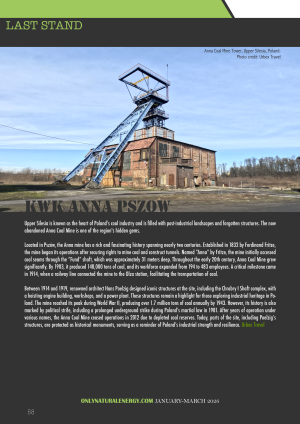
 Upper Silesia is known as the heart of Poland’s coal industry and is filled with post-industrial landscapes and forgotten structures. The now abandoned Anna Coal Mine is one of the region’s hidden gems.
Located in Pszów, the Anna mine has a rich and fascinating history spanning nearly two centuries. Established in 1832 by Ferdinand Fritze, the mine began its operations after securing rights to mine coal and construct tunnels. Named “Anna” by Fritze, the mine initially accessed coal seams through the “Fund” shaft, which was approximately 31 meters deep. Throughout the early 20th century, Anna Coal Mine grew significantly. By 1903, it produced 148,000 tons of coal, and its workforce expanded from 194 to 483 employees. A critical milestone came in 1914, when a railway line connected the mine to the Olza station, facilitating the transportation of coal.
Between 1914 and 1919, renowned architect Hans Poelzig designed iconic structures at the site, including the Chrobry I Shaft complex, with a hoisting engine building, workshops, and a power plant. These structures remain a highlight for those exploring industrial heritage in Poland. The mine reached its peak during World War II, producing over 1.7 million tons of coal annually by 1943. However, its history is also marked by political strife, including a prolonged underground strike during Poland’s martial law in 1981. After years of operation under various names, the Anna Coal Mine ceased operations in 2012 due to depleted coal reserves. Today, parts of the site, including Poelzig’s structures, are protected as historical monuments, serving as a reminder of Poland’s industrial strength and resilience.
-

By: ONE Team
ONE is a nonprofit magazine founded in 2014, dedicated to providing unbiased and independent commentary and reporting on energy and environment issues. ONE policy pursues the following principles: accuracy, integrity and transparency.
Only Natural Energy provides original articles and also a selection of other sources most explanatory posts about climate change, new technologies, policies and strategies in the energy field. -