
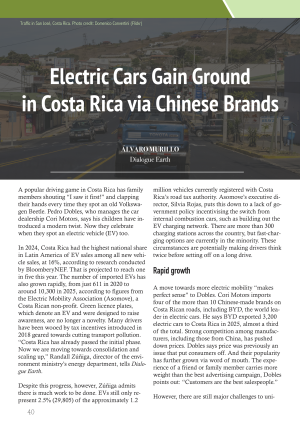
 Despite challenges, Costa Rica is Latin America’s most dynamic electric car market thanks to government incentives and Chinese manufacturers
A popular driving game in Costa Rica has family members shouting “I saw it first!” and clapping their hands every time they spot an old Volkswagen Beetle. Pedro Dobles, who manages the car dealership Cori Motors, says his children have introduced a modern twist. Now they celebrate when they spot an electric vehicle (EV) too.
In 2024, Costa Rica had the highest national share in Latin America of EV sales among all new vehicle sales, at 16%, according to research conducted by BloomberyNEF. That is projected to reach one in five this year. The number of imported EVs has also grown rapidly, from just 611 in 2020 to around 10,300 in 2025, according to figures from the Electric Mobility Association (Asomove), a Costa Rican non-profit. Green licence plates, which denote an EV and were designed to raise awareness, are no longer a novelty. Many drivers have been wooed by tax incentives introduced in 2018 geared towards cutting transport pollution. “Costa Rica has already passed the initial phase. Now we are moving towards consolidation and scaling up,” Randall Zúñiga, director of the environment ministry’s energy department, tells Dialogue Earth.
Despite this progress, however, Zúñiga admits there is much work to be done. EVs still only represent 2.5% (29,805) of the approximately 1.2 million vehicles currently registered with Costa Rica’s road tax authority. Asomove’s executive director, Silvia Rojas, puts this down to a lack of government policy incentivising the switch from internal combustion cars, such as building out the EV charging network. There are more than 300 charging stations across the country, but fast-charging options are currently in the minority. These circumstances are potentially making drivers think twice before setting off on a long drive.
Rapid growth
A move towards more electric mobility “makes perfect sense” to Dobles. Cori Motors imports four of the more than 10 Chinese-made brands on Costa Rican roads, including BYD, the world leader in electric cars. He says BYD exported 3,200 electric cars to Costa Rica in 2025, almost a third of the total. Strong competition among manufacturers, including those from China, has pushed down prices. Dobles says price was previously an issue that put consumers off. And their popularity has further grown via word of mouth. The experience of a friend or family member carries more weight than the best advertising campaign, Dobles points out: “Customers are the best salespeople.”
However, there are still major challenges to universal adoption. Federico Villalobos, a road infrastructure consultant, says some aspects of electric mobility policy have been misguided. Despite government incentives to increase EV use, road infrastructure has not been improved, he says. The combination of incentives for EV drivers and reduced fuel duty revenue could also leave the state with fewer resources to invest in roads or subsidise public transportation projects, he warns: “Efforts have been made with good intentions, but they are partial and the problem is more complex.”
The industry has also had to challenge the prevailing Costa Rican belief that diesel engines are superior. Andrea Morales, sustainability manager for a construction company, says her father was one of those who initially doubted EVs. After she convinced him to try one, his small Chevrolet Spark became his favourite mode of transport. “I don’t know anyone who has regretted switching to an electric vehicle,” she adds. Manuel Delgado, a YouTube content creator who specialises in technology and electric mobility, says the turning point for EVs in Costa Rica came in 2021, when annual domestic EV sales hit 1,000 for the first time. Billboards sprang up in cities and along main roads, and influential figures jumped on the bandwagon. Alajuelense, one of the country’s biggest football clubs, struck a sponsorship deal with BYD.
The geopolitical factor and challenges
As the US and China butt heads over international trade, the fear of potential tariffs on Chinese vehicles looms over the industry. The US could pressure Costa Rica to withdraw fiscal incentives for EVs to damage Chinese interests, for example. Rojas says that, although the industry is closely following tariff news, the imposition of duties is unlikely. The auto sector is not considered to be of strategic interest to the US in comparison to telecommunications or ports, she says. As far as the government is concerned, says Zúñiga, its priority when selecting which EVs to import is compliance with technical and safety standards: “No specific origins are promoted. Risk management is addressed through diversification of suppliers and clear rules, not from a geopolitical perspective.”
Meanwhile, the road to consolidating electric mobility is obstructed by yet more challenges. The widescale electrification and improvement of public transport remains key in dealing with pollution and congestion. A recent report by Numbeo, a platform that compiles crowdsourced data, ranks Costa Rica as having the second worst traffic in the world. That’s largely in terms of time spent in commuter traffic and the resulting dissatisfaction and CO2 emissions. Government plans for an electric train in the capital, San José, are moving forward.
Growing the fast-charging network is also a challenge due to legal restrictions on private companies selling electricity. To get around this restriction, private companies offer free charging to attract customers to their money-making enterprises. As such, there are currently only 77 public charging stations in the country and another 250 provided by stores, banks and restaurants, according to figures from Asomove. And most of these remain concentrated in urban areas, which does not tackle drivers’ long-distance anxiety.
Aside from the universal benefits of cleaner air and a reduction in planet-warming emissions, the growth of EVs presents a rarer opportunity to the country: the Costa Rican company, Fortech, claims to be the only lithium battery recycler in Central America. Guillermo Pereira, Fortech’s executive director, says its renewables-powered plant processed about 2,000 tonnes of batteries in 2025, including almost 300 from EVs. “Lithium batteries are a resource that cannot be wasted,” Pereira says. If more of Central America catches up to Costa Rica’s burgeoning enthusiasm for electric mobility, the country could reap the economic benefits of this head start on recycling.
Álvaro Murillo
Originally published
by Dialogue Earth
February 26, 2026
-

By: Dialogue Earth
Dialogue Earth is an independent non-profit dedicated to producing exceptional environmental journalism and informed conversations on urgent climate and sustainability topics. Our unique model brings local voices to global audiences and global stories of hope, action and change to local communities. We are committed to accurately portraying China’s development impacts across the Global South through geopolitically even-handed reporting and constructive dialogue. Our approach is rooted in a network of specialist country editors located across South and Southeast Asia, Africa and Latin America, and delivered through reporting in eight languages, workshops, and media partnerships. We seek to bring light, rather than heat, to crucial debates, and solutions to bear on complex problems.
-