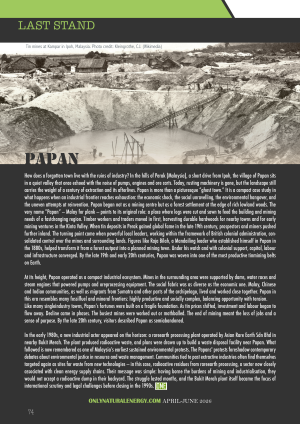
 How does a forgotten town live with the ruins of industry? In the hills of Perak (Malaysia), a short drive from Ipoh, the village of Papan sits in a quiet valley that once echoed with the noise of pumps, engines and ore carts. Today, rusting machinery is gone, but the landscape still carries the weight of a century of extraction and its afterlives. Papan is more than a picturesque “ghost town.” It is a compact case study in what happens when an industrial frontier reaches exhaustion: the economic shock, the social unravelling, the environmental hangover, and the uneven attempts at reinvention. Papan began not as a mining centre but as a forest settlement at the edge of rich lowland woods. The very name “Papan” — Malay for plank — points to its original role: a place where logs were cut and sawn to feed the building and mining needs of a fastchanging region. Timber workers and traders moved in first, harvesting durable hardwoods for nearby towns and for early mining ventures in the Kinta Valley.
When tin deposits in Perak gained global fame in the late 19th century, prospectors and miners pushed further inland. The turning point came when powerful local leaders, working within the framework of British colonial administration, consolidated control over the mines and surrounding lands. Figures like Raja Bilah, a Mandailing leader who established himself in Papan in the 1880s, helped transform it from a forest outpost into a planned mining town. Under his watch and with colonial support, capital, labour and infrastructure converged. By the late 19th and early 20th centuries, Papan was woven into one of the most productive tinmining belts on Earth.
At its height, Papan operated as a compact industrial ecosystem. Mines in the surrounding area were supported by dams, water races and steam engines that powered pumps and oreprocessing equipment. The social fabric was as diverse as the economic one. Malay, Chinese and Indian communities, as well as migrants from Sumatra and other parts of the archipelago, lived and worked close together. Papan in this era resembles many fossilfuel and mineral frontiers: highly productive and socially complex, balancing opportunity with tension.
Like many singleindustry towns, Papan’s fortunes were built on a fragile foundation. As tin prices shifted, investment and labour began to flow away. Decline came in phases. The busiest mines were worked out or mothballed. The end of mining meant the loss of jobs and a sense of purpose. By the late 20th century, visitors described Papan as semiabandoned.
In the early 1980s, a new industrial actor appeared on the horizon: a rareearth processing plant operated by Asian Rare Earth Sdn Bhd in nearby Bukit Merah. The plant produced radioactive waste, and plans were drawn up to build a waste disposal facility near Papan. What followed is now remembered as one of Malaysia’s earliest sustained environmental protests. The Papans’ protests foreshadow contemporary debates about environmental justice in resource and waste management. Communities tied to past extractive industries often find themselves targeted again as sites for waste from new technologies — in this case, radioactive residues from rareearth processing, a sector now closely associated with clean energy supply chains. Their message was simple: having borne the burdens of mining and industrialisation, they would not accept a radioactive dump in their backyard. The struggle lasted months, and the Bukit Merah plant itself became the focus of international scrutiny and legal challenges before closing in the 1990s.
-

By: ONE Team
ONE is a nonprofit magazine founded in 2014, dedicated to providing unbiased and independent commentary and reporting on energy and environment issues. ONE policy pursues the following principles: accuracy, integrity and transparency.
Only Natural Energy provides original articles and also a selection of other sources most explanatory posts about climate change, new technologies, policies and strategies in the energy field. -