 A century ago, critics of cities called them concrete jungles. According to Dictionary.com, concrete jungles are “any large, crowded city or urban area with little greenery or access to nature.” A significant amount of city space is dominated by concrete, steel, asphalt, old industrial areas, and other eyesores. Therefore, it is necessary to revamp cities to make them more appealing and more pleasant places in which to live. This can be achieved by increasing the amount of urban green spaces so that they are more natural and parklike. Unfortunately, it is difficult to do so because of the high cost of real estate and a shortage of empty space in which to create new parks. One way to overcome this dilemma is to install green treatments on the walls of existing buildings. There are many advantages of establishing green walls. An article in the Journal of Green Building reported that “Green walls not only bring nature back into city life, they do so in a way that is accessible to everyone.” Green walls also help reduce air and noise pollution, urban heat islands, climate change, cooling costs, and stress. Additionally, green walls promote greater biodiversity and improve people’s health.
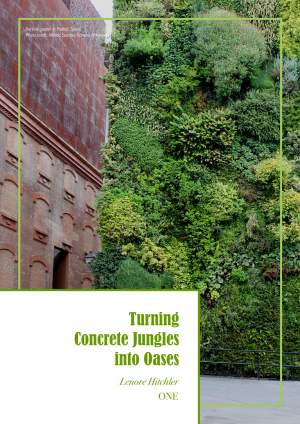
The term “Green walls” refers to internal and external walls that are covered with vegetation. However, in this article, “green walls” will refer only to the exterior green walls of buildings. Various other terms are also used for green walls, such as living walls, bio-walls, plant walls, green facades, vertical greenery, vertical gardens, vertical vegetation, and vertical greenery systems.
In the future, the number of green walls will probably increase. Unfortunately, it is extremely difficult to estimate the total amount of surface that could potentially be dedicated to green walls. Obviously, a vast amount of land in cities is already taken up by buildings. Therefore, a substantial amount of space could be devoted to green walls. For example, the New York City Department of City Planning reported that approximately 60% of the city’s total land is occupied by buildings. Various articles in professional journals further show the potential amount of surface that could be devoted to green walls. For instance, an article in Environmental Science and Pollution Research stated that: “Vertical greenery can cover more exposed hard surfaces than horizontal greenery.” Also, an article in the International Journal of Advanced Engineering Research and Science reported that if high-rise buildings were covered with green walls, their facades would hold more vegetation than was originally located at the site. Still another example is found in an article in Renewable and Sustainable Energy Reviews, which reported that “the surface area of the walls of buildings is always greater than the area of the roof. With high-rise buildings this can be as much as 20 times the roof area.”
Unfortunately, there are some issues regarding green walls that must be addressed. For example, zoning codes may prohibit green walls. Also, construction permits may be required.
Additionally, the building itself should be protected from being damaged by the green walls. The building must be able to support the added weight of the substrate layer used to grow the plants, plus the plants themselves. Depending on the plant species used and the surrounding climate, green wall plantings may need watering, and this additional weight, humidity, and moisture may damage the building façade. In addition, installing and maintaining green walls is more expensive than leaving the walls bare.
Establishing green walls benefits both the owners and occupants of the building and the environment within and surrounding the building. However, to substantially enhance the total urban environment, it is necessary to spread green walls throughout the area. In addition, they are merely one component of a comprehensive greening policy that also includes green roofs, street trees, other green landscaping, and parks.
Although green walls benefit their owners, their use can cause difficulties for the original residents of the neighborhood. According to an article in Urban Studies, “The empirical results indicate that newly added green spaces potentially foster gentrification, influencing the replacement of the poor with wealthier inhabitants.” Further evidence is provided by an article in the International Journal of Advanced Engineering Research and Science, which stated that: “the vertical garden can push the property value up to 15% compared to buildings in the same location with no greenery systems.” This increase in real estate values leads to the rise of higher real estate taxes for the original homeowners who can no longer afford to live in the neighborhood. Those who rent apartments pay higher rents, since the value of apartments is higher in gentrified neighborhoods. Thus, many of the original residents of the area are forced to leave their community. Unfortunately, the resulting social disruption to neighborhoods is detrimental to the psyche and the general health of the original inhabitants.
Despite the negative features regarding green walls, there are many positive contributions of them to the environment and the populace. For instance, green walls can help mitigate climate change. Carbon dioxide is one of the greenhouse gases that cause climate change. Fortunately, the plants on green walls take up carbon dioxide during photosynthesis and serve as carbon sinks, thus reducing the greenhouse effect that causes climate change.
Climate change contributes to the creation of urban heat islands. According to an article published in the Journal of Green Building, “Studies have found urban air temperature of up to 12 degrees centigrade higher than surrounding areas.” Fortunately, green walls can lower the surrounding air temperature and thus mitigate urban heat islands.
Besides mitigating urban heat islands, green walls can help prevent damage from flooding caused by severe rainstorms. The plants located on green walls help retain rainwater, thus slowing down the amount of rain that quickly floods sewers during severe storms. The Journal of Green Building reported that: “Having stormwater percolate through a green wall system can lead to a near total elimination of pollution before being released back into the surrounding environment. This process is carried out by the roots (and microorganisms living around them), which break down and utilize the dissolved contaminants.”
In addition to preventing damage from severe storms, urban green walls help lower the levels of air pollution. Unfortunately, air pollution damages people’s health. Air pollution increases the rates of allergies and various respiratory and heart diseases. The plants on green walls reduce air pollution in several ways. According to an article in Building and Environment, “the microbial activity in the root systems filters volatile organic compounds from the air. Particulate matter is captured and retained on the leaves.”
Besides mitigating air pollution, green walls also reduce noise pollution. An article in the Journal of Green Building stated that green walls “insulate against noise, vibrations, and reduce sound penetration.” Traffic noise is especially irritating. According to an article in Building and Environment, “vertical gardens had a beneficial effect in mitigating noise from traffic.” Another study from the same article “found vertical gardens led to sound levels being reduced by up to three times.”
In addition to reducing various types of pollution, green walls also help to reduce temperatures inside buildings. An article in the Journal of Green Building reported that “Covering a building with foliage naturally shades it and depending on the type of green wall used can give additional insulating properties. This will result in a considerably less amount of heat being radiated inward. Some studies have shown that green walls can cut electricity bills by up to 30%.” The United States Department of Energy stated that the general rule is a 1% savings for each 1 degree Fahrenheit temperature change, either for cooling or heating.” In addition to green walls shading buildings, the evapotranspiration of the plants on green walls also helps keep the interior space inside buildings cool.
Various articles from professional journals also report on the cooling effects of green walls. An article in Environmental Science and Pollution Research reported that living walls reduce the inner temperature of buildings by up to 10 degrees centigrade. An article in Building and Environment reported that a study found that vertical greenery systems had a 4 to 11 degrees centigrade lower surface temperature than non-vegetated walls. A similar estimate was reported in the Journal of Green Building. The article stated that “up to 30% of energy consumption for air conditioning can be reduced by using green walls.”
Ivy-covered green walls have been around for quite a while and are effective at helping keep buildings cooler. An article in Experimental Heat Transfer reported that an ivy-covered wall “reduced the peak-cooling load transferred through the west-facing wall by 28% on a clear summer day.”
In addition to keeping people cooler, green walls help maintain biodiversity. The Journal of Green Building stated that the variety of plant species on green walls “supports many beneficial organisms such as butterflies, bees, ladybugs, and hummingbirds.” Also, the authors of an article in Building and Environment reported that the green walls that they studied hosted over 100 animal species, including insects, spiders, and birds. In comparison, the non-vegetated walls only incorporated a few species.
One way that green walls help to maintain biodiversity is that they help to connect various fragments of nature to each other. An article in Land Use Policy reported that “Green walls can support biodiversity in cities at a landscape scale by acting as a “corridor” or “stepping stone” to facilitate movement and dispersal. … The European Union Green Infrastructure Policy, which is linked to the European 2020 Biodiversity Strategy, recognizes that connectivity is key for biodiversity resilience against change and further highlights green walls as an important, and cost effective element, of green infrastructure in the urban environment.”
Besides providing shelter for various animal species, green walls can also host various edible plants. For example, there are many vines that produce edible food, such as grapes and the American groundnut. The Environment Design Guide, TEC 26: Living Walls – A Way to Green the Built Environment, was published by the Royal Australian Institute of Architects. According to the guide, mint, rosemary, thyme, tarragon, oregano, and chia plants can be grown on green walls.
In addition to adding healthier plant products to the urban diet, green walls improve people’s health. An article in Social Science & Medicine found that “the quantity and quality of streetscape greenery is associated with health, more so than the quantity and quality of nearby green areas.”
Street greenery can entice people to increase their walking levels, and doing so is extremely healthy. An article in Social Science & Medicine reported that “According to several national surveys, streets are the most popular setting for walking, cycling, and physical activity, followed by home and then parks. Our results suggest that walking behavior is at least as strongly affected by eye-level street greenery as by parks. The presence of walkable green streets is also related to longer life spans for older adults.”
One aspect of the contribution of green walls to people’s health is that they help to reduce stress. An article in Urban Forestry & Urban Greenery stated that “recent research reported that green stimuli promote positive responses, such as wellbeing, pleasure, and relaxation evidenced by cerebral blood flow.” Another study from the same article found that “viewing a green façade landscape resulted in a significant increase in parasympathetic nerve activity to render a state of relaxation.” An article in Landscape and Urban Planning reported that “Past research has shown that the color green may produce anxiety-reducing effects.”
Further evidence of the stress-relieving ability of greenspace is provided by an article in Landscape and Urban Planning. The authors reported that “Being in or viewing green space has been shown to reduce physiological measures of stress, including blood pressure, heart rate, and skin conductance and muscle tension.”
Exposure to green walls lasts a very short time. However, this short duration is still valuable. According to an article in the International Journal of Environmental Research and Public Health, “Studies have found significant stress reduction effects for short periods of exposure in small-scale green environments.” An article in Landscape and Urban Planning reported that a “study of exposure to green space and mental health showed the strongest positive effects on mood and self-esteem for the shortest duration (5 minutes) of activity in green space.” This is good news because many encounters with green walls are brief glimpses while walking or bicycling.
Thus, it is possible to establish green walls to make concrete jungles more like oases. Oases and green walls have several things in common. They both add greenery and signs of life to visually barren surroundings. Both provide beauty for people to look at and admire. Relief, respite, and solace abound in both locations.Various wildlife is attracted to both areas. Climate change increases deserts, and green walls decrease the effects of climate change. Desert dwellers obtain water at oases, while green walls remove excess water from severe storms. Also, oases and green walls resemble gardens. Hopefully, the number of green roofs in the future will increase like weeds in a garden.
Lenore Hitchler
-

By: ONE Team
ONE is a nonprofit magazine founded in 2014, dedicated to providing unbiased and independent commentary and reporting on energy and environment issues. ONE policy pursues the following principles: accuracy, integrity and transparency.
Only Natural Energy provides original articles and also a selection of other sources most explanatory posts about climate change, new technologies, policies and strategies in the energy field. -